What happens when budgets are tight?
Book sales are not the only way to measure reach.
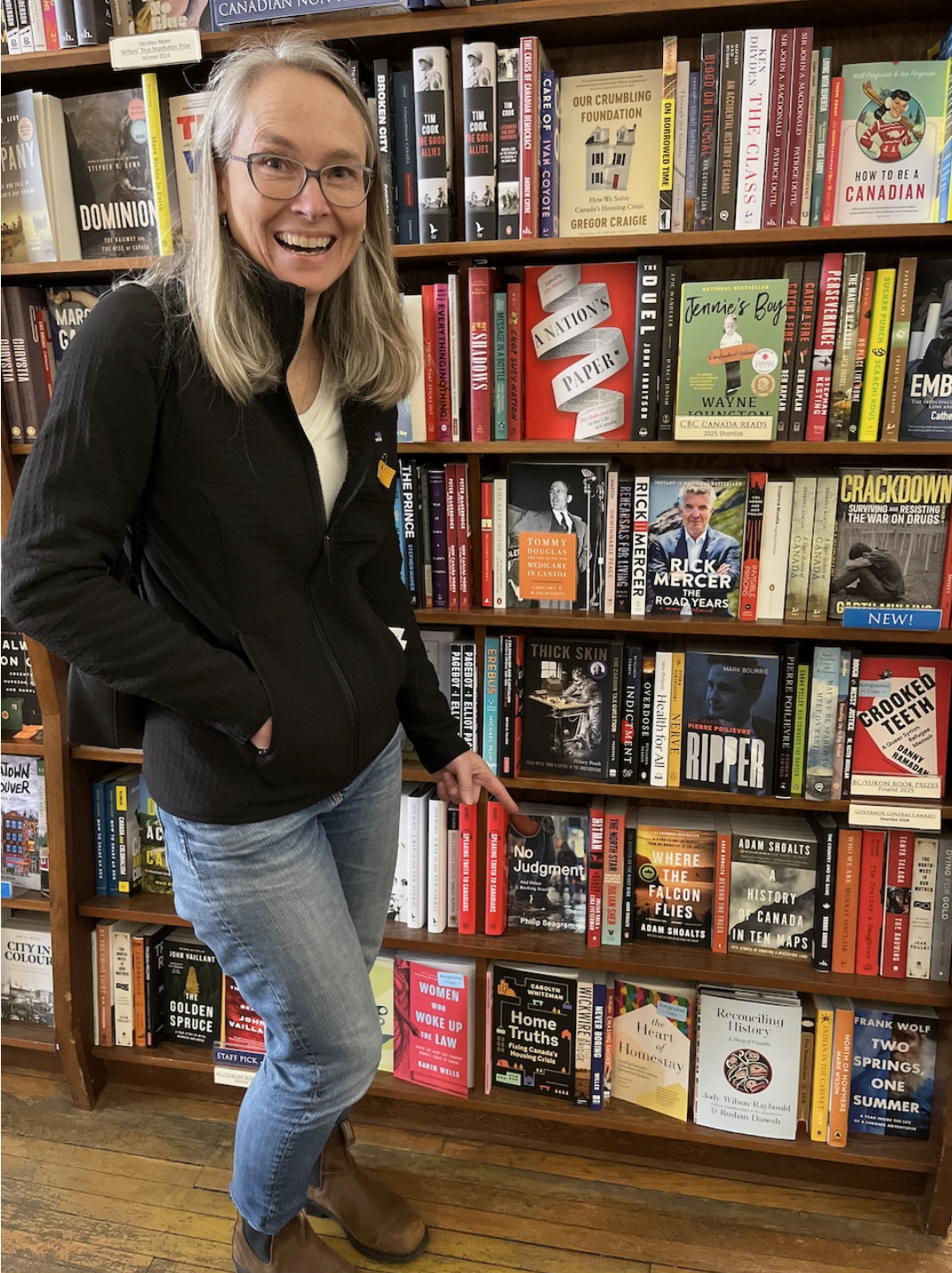
You can tell from my expression in the photo below that I was beyond excited to see my book in stock at Munro's Books in Victoria. But there is another kind of bookshelf that's also meaningful to authors, and it's really important when budgets are tight.
Right now, that's the case for international education. Our industry has been dealt a series of tough blows in the last few years—first by COVID, and more recently by a swell of anti-immigration sentiments and funding cuts. This is happening not just in Canada—where federal policy changes have knocked student registrations in half for many schools—but in the US, Australia, and the UK as well.
Despite these circumstances, some international education programs are seeing my book as a resource that will inspire their teams and host families during tough times and strengthen their programs in the long term. I’m deeply grateful for their support and encouragement.
Thankfully, there’s another option in every author’s marketing toolkit. It’s simple, easy, and sensible. Best of all, it’s completely free.
Libraries.
When my kids were little, the library was one of our favourite places to hang out. We checked out stacks of books at every visit, arms laden with treasures. We bought dozens of books at the annual book sale at a fraction of the price I’d pay elsewhere. I’m still a regular patron of the library, and recently switched from Audible to Libby to satisfy my audiobook habit.
Libraries are not just wonderful for readers. For authors, they’re an often-overlooked way to reach people who might not be able to buy our book, or who would never have found our book in the first place.
Here in Canada (and in over 30 other countries worldwide), the Public Lending Right (PLR) program recognizes this impact by compensating authors for their work. In some countries, payments to eligible authors are based on library lending. In other countries, it’s the total number of copies of each book held in libraries. In Canada, payments are based on the presence of a title in public library catalogues that are consulted during the annual PLR survey. The calculation of PLR payments is determined by the PLR Commission, an advisory body of the Canada Council for the Arts.
Whenever I speak to someone about my book, my goal is to reach a wider audience, not just make another sale. That’s why, in addition to asking them to shop at their local bookstore, or offering them bulk order discounts, I also ask them to request my book at their library.
When was the last time you checked out a library book? Remember: if you can’t find the title you’re looking for, take a few minutes to ask for it. Your request does make a difference—not only for yourself and your fellow patrons, but also for the author.